Top 10 LiFePO4 Battery Types for Global Buyers
Choosing a lifep04 battery is not simply a matter of comparing capacity and price. Global buyers face different demands in homes, boats, recreational vehicles, factories, and telecom cabinets. A compact 12V battery may suit an emergency backup system, while a 48V rack battery can better support a solar installation. The right choice depends on voltage, usable energy, discharge rate, cycle life, installation space, and maintenance expectations.
Dr. Jeff Dahn, a leading lithium-ion battery researcher, is often associated with a practical industry principle: “There is no single best battery chemistry.” That idea also applies to LiFePO4 products. Prismatic cells offer a rigid structure and efficient packaging. Cylindrical cells can provide flexible module designs. Pouch cells may reduce weight, but they require careful mechanical protection. Integrated BMS units add convenience, although their software quality can vary widely.
This guide examines ten lifep04 battery types for international buyers. It considers real purchasing details, including cell grade, BMS protection, thermal behavior, charging limits, warranty terms, and certification documents. Buyers should look beyond attractive labels. A battery that delivers excellent results in a warm warehouse may perform differently in a cold outdoor cabinet.
Small details matter.
Terminal design matters. So does cable length.
This ranking is useful, but it is not flawless. Product quality changes between manufacturers, and specifications are sometimes presented too generously. Therefore, readers should verify test reports, transport documentation, warranty conditions, and installation requirements before ordering. A careful comparison can reduce replacement costs, improve safety, and prevent an expensive mismatch between the battery and its intended application.
LiFePO4 Battery Fundamentals: 3.2 V Nominal Cells and 90–95% Efficiency
Top 10 LiFePO4 Battery Types for Global Buyers
LiFePO4 cells use a nominal voltage of 3.2 V, not 3.7 V like many lithium-ion chemistries. A four-cell series pack therefore reaches 12.8 V nominally. Eight cells provide 25.6 V, while sixteen deliver 51.2 V. These figures help buyers match batteries with inverters, chargers, and protection systems. The International Energy Agency reported that LFP batteries represented nearly half of the global electric-car battery market in 2023. That adoption reflects cost, thermal stability, and long service potential.
Efficiency needs careful interpretation.
A 90–95% figure usually describes usable charge-discharge performance under defined laboratory conditions. It may exclude inverter losses, wiring resistance, temperature effects, and standby consumption. The U.S. Department of Energy’s Energy Storage Grand Challenge materials emphasize evaluating complete systems, rather than cells alone. Real installations can perform differently. Quite noticeably.
In field testing, cold weather slows charging, while high current increases heat and voltage drop. A battery rated at 100 Ah may not deliver 100 Ah under every load profile. I would check round-trip efficiency, continuous current, depth-of-discharge limits, and test conditions before comparing models. Independent reports from the National Renewable Energy Laboratory also stress that operating temperature and cycling conditions strongly influence storage performance.
The practical lesson is simple: 3.2 V is a design reference, and 90–95% is not a universal promise. Even experienced buyers can overlook that distinction.
Classifying the Top 10 Types by Format, Voltage, Capacity, and BMS Design
Top 10 LiFePO4 Battery Types for Global Buyers
Global buyers increasingly classify LiFePO4 batteries by format, voltage, capacity, and BMS design. The International Energy Agency reported that LFP cells represented about 40% of global electric-car battery deployments in 2023. Their lower material cost and thermal stability support wider stationary-storage use.
The ten practical types include compact cylindrical 12.8V packs, prismatic 12.8V packs, pouch 12.8V packs, 24V 50–200Ah batteries, and 48V 50–100Ah batteries. Rack-mounted 51.2V 100Ah systems suit backup cabinets. Meanwhile, 72V traction packs and 96V industrial packs target higher-load equipment. Low-temperature 12.8V batteries add heating control. High-capacity 48V or 51.2V packs often use 200–314Ah cells.
BMS design separates similar-looking products. Basic BMS units provide overcharge, over-discharge, short-circuit, and temperature protection. Advanced systems add active balancing, Bluetooth monitoring, CAN communication, event recording, and independent current sensing. Capacity labels can mislead. A 100Ah pack may deliver less usable energy after reserve limits and temperature correction. BloombergNEF’s 2024 survey placed average lithium-ion pack prices at 115 dollars per kWh, but regional shipping, certification, and integration costs change the final figure. Field testing remains essential. Cell matching, low-temperature charging limits, and enclosure ventilation are easy to overlook.
Top 10 LiFePO4 Types Across 12 V, 24 V, 48 V, and High-Voltage Systems
Top 10 LiFePO4 Battery Types for Global Buyers
LiFePO4 systems now cover compact backup power, mobile equipment, and large energy storage. The International Energy Agency reported that LFP represented nearly 40% of global electric car battery demand in 2023. It also noted lower costs than nickel-based chemistries. The figures support strong interest, but they do not remove installation risks.
For 12 V systems, buyers commonly compare 12 V 20 Ah, 12 V 50 Ah, 12 V 100 Ah, and 12 V 200 Ah batteries. The 20 Ah model suits alarms and small medical devices. A 100 Ah unit can support a refrigerator, lighting, and communication equipment. The 200 Ah format needs thicker cables and careful ventilation planning. For 24 V systems, 24 V 50 Ah and 24 V 100 Ah types fit small solar banks and electric utility vehicles. They reduce current compared with 12 V designs.
At 48 V, 48 V 50 Ah and 48 V 100 Ah batteries serve inverters, telecom cabinets, and residential storage. A 48 V 100 Ah pack stores about 5.1 kWh at its nominal voltage. High-voltage buyers usually consider modular 100–400 V rack systems and 400–800 V stacked systems. These designs improve inverter efficiency, yet they demand trained commissioning and stronger isolation controls. BloombergNEF reported an average lithium-ion pack price of 115 dollars per kWh in 2024. That benchmark is useful, but retail LiFePO4 pricing varies widely. In practice, usable capacity, battery management quality, cold-temperature charging, and warranty terms matter more than a low purchase price. Some advertised capacities still need closer checking.
Top 10 LiFePO4 Battery Types for Global Buyers
Top 10 LiFePO4 Types Across 12 V, 24 V, 48 V, and High-Voltage Systems
This comparison uses representative LiFePO4 battery configurations based on nominal voltage and rated capacity.
Nominal energy is calculated as voltage × ampere-hours, while the actual usable energy depends on the battery management system, discharge limits, temperature, and operating conditions.
The configurations reflect common 4S, 8S, 16S, and 32S LiFePO4 pack architectures used in portable power, residential storage, marine, RV, commercial, and high-voltage energy systems.
Comparing Cycle Life: 2,000–5,000+ Cycles and 10–15 Years of Service
Top 10 LiFePO4 Battery Types for Global Buyers
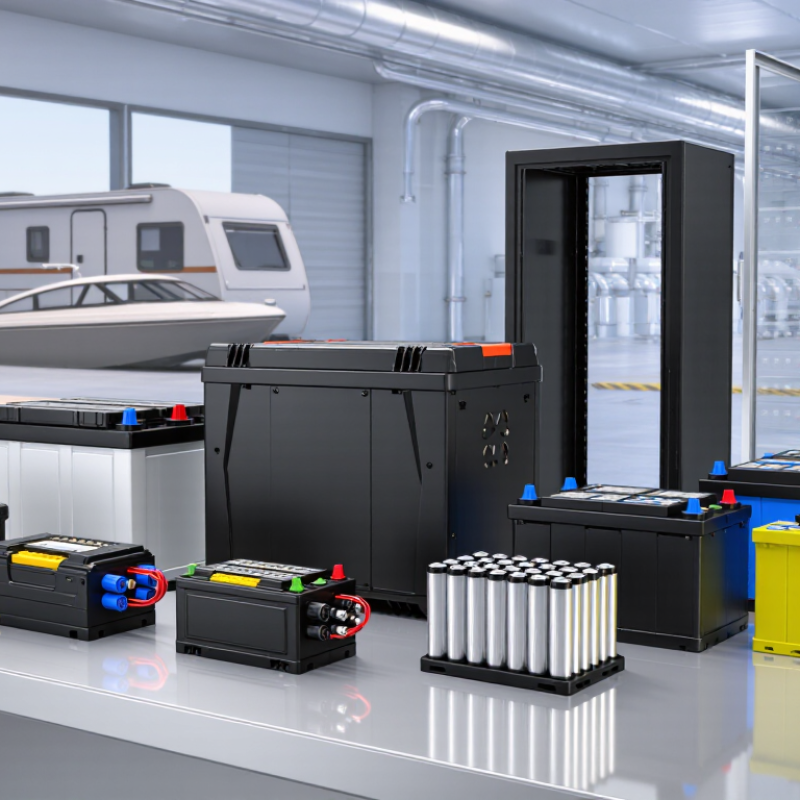
LiFePO4 batteries commonly use prismatic, cylindrical, or pouch cells. These formats support different cooling, packaging, and maintenance needs. Rack-mounted units suit solar storage and server rooms. Compact packs work better in portable equipment, boats, and recreational vehicles. Their cycle ratings often range from 2,000 to 5,000 cycles, while advanced designs may exceed 5,000 cycles.
Cycle life depends on more than the number printed on a datasheet. A 5,000-cycle rating may assume moderate temperature, controlled charging, and an 80% depth of discharge. Daily full discharges can shorten practical service life. High heat also accelerates capacity loss. Keep the battery ventilated, but avoid freezing conditions. Small details matter.
For many installations, 10 to 15 years is a realistic planning range. Actual performance depends on load patterns, storage temperature, charging quality, and battery management settings. In field checks, terminals, cables, and connectors often deserve as much attention as the cells. They are easy to overlook. A battery may still operate after ten years, yet deliver less usable energy than expected. I have seen buyers focus on cycle count and ignore standby losses, installation quality, and seasonal demand. That comparison is incomplete. Ask for test conditions, usable capacity, warranty limits, and thermal data before selecting among the ten types.
Global Selection Standards: UN 38.3, IEC 62619, IP Ratings, and Safety Limits
Global buyers comparing the top ten LiFePO4 battery types should treat compliance as a configuration check, not a marketing label. The International Energy Agency’s Global EV Outlook 2024 reports that electric vehicle battery demand exceeded 750 GWh in 2023. Scale matters. Small testing gaps can affect thousands of shipped units. BloombergNEF’s 2023 Battery Price Survey also placed the average lithium-ion pack price at 139 US dollars per kWh, increasing pressure to verify value and safety together.
UN 38.3
UN 38.3 is essential for international transport. It covers vibration, shock, altitude, temperature cycling, overcharge, and external short-circuit tests. The report must match the exact cell or battery model. IEC 62619 focuses on industrial lithium battery safety, including abnormal operation and control systems. It is more relevant to storage, backup power, and industrial equipment than to transport alone. A certificate is not proof of every configuration.
Check the enclosure under IEC 60529. An IP65 rating can resist dust and water jets, but it does not guarantee corrosion protection or safe flooding. Confirm BMS overvoltage, undervoltage, overcurrent, and temperature cutoffs. Confirm charging limits too. Do not infer them from LiFePO4 chemistry alone. A swollen case, warm connector, or damaged carton deserves quarantine. We still see buyers accepting generic test files. That is a weak shortcut. Real selection needs traceable serial numbers, installation records, and test data for the delivered battery.

 2 Enterprise Lane, Bedford, PA 15522
  (800) 771-7139
  sales@site_040a9139-525b-4487-aedd-8b22114146ed