2 Enterprise Lane, Bedford, PA 15522
  (800) 771-7139
  sales@site_040a9139-525b-4487-aedd-8b22114146ed
Why Choose LFP Battery for Global Buyers?
Global buyers are rethinking battery value. Price still matters, but reliability matters more. An lfp battery offers a practical balance between safety, cycle life, and material cost. Its chemistry uses iron and phosphate instead of nickel and cobalt. That difference can reduce exposure to volatile mineral prices and complicated supply chains.
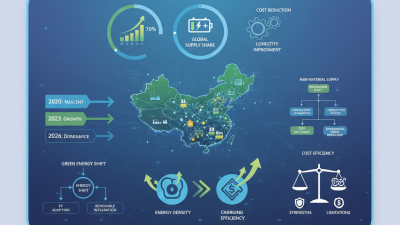
The International Energy Agency’s Global EV Outlook 2024 reported that LFP batteries represented about 40% of the global electric vehicle battery market in 2023. The report also noted their lower cost and strong safety profile, despite lower energy density. BloombergNEF’s 2023 Battery Price Survey placed average LFP pack prices near $130 per kilowatt-hour. NMC packs averaged about $152 per kilowatt-hour. These figures are useful, not perfect. Prices vary by region, order volume, and cell quality.
Elon Musk said during Tesla’s Q1 2022 earnings call, “My personal opinion is that LFP batteries are better for the vast majority of applications where energy density is not a priority.” That view reflects a growing market reality. Electric buses, stationary storage systems, delivery fleets, and entry-level vehicles often value long service life over maximum range. An lfp battery can also tolerate frequent charging and deeper daily cycling. Still, buyers should inspect warranty terms, thermal controls, certification records, and real-world cycle data. Chemistry alone does not guarantee performance. Manufacturing quality can change everything. That is the part many comparisons overlook.
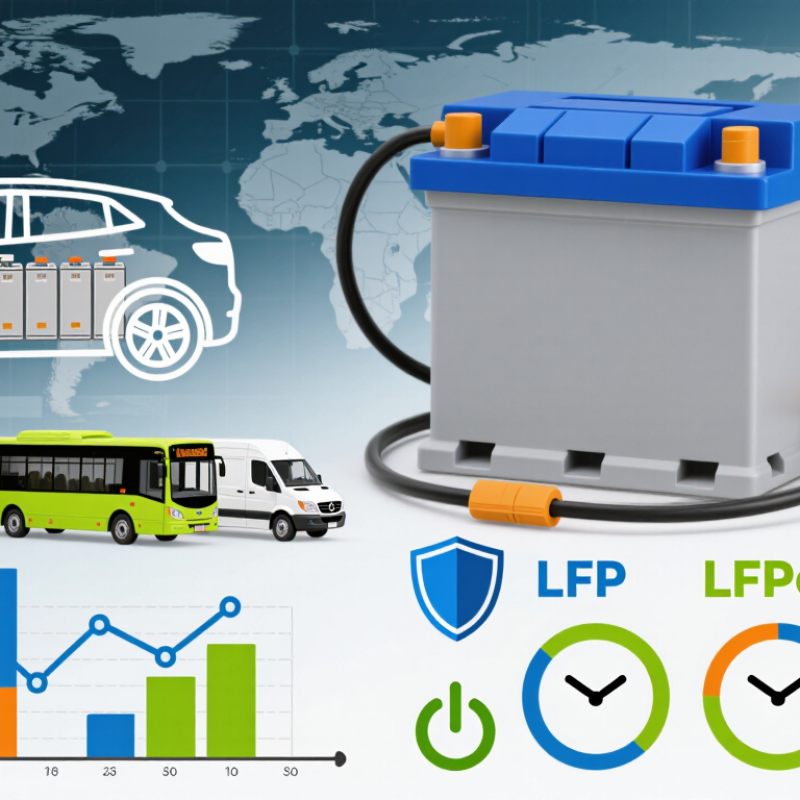
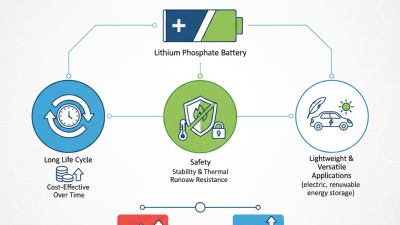
An LFP battery uses lithium iron phosphate as its cathode material. Its anode commonly uses graphite, while a separator and electrolyte enable ion movement. During charging, lithium ions move toward the graphite anode. During discharge, they return through the electrolyte.
This chemistry avoids nickel and cobalt. It offers strong thermal stability and usually supports many charge cycles. The International Energy Agency’s Global EV Outlook 2024 reported that LFP batteries represented about 40% of the global electric vehicle battery market in 2023. They can also cost less than nickel-based chemistries. However, LFP batteries generally have lower energy density. That trade-off matters. A heavier battery may affect vehicle range, shipping costs, or installation space.
Tips: Ask for independent test data, not only laboratory claims. Check cycle-life results at your expected temperature and charging rate. Review usable capacity, warranty conditions, safety testing, and recycling arrangements. For solar storage, measure daily energy demand and reserve requirements first. For vehicles, examine cold-weather performance carefully. LFP is not a perfect answer. Its lower energy density can become inconvenient in compact designs. Yet, for buyers prioritizing stability, durability, and predictable operating costs, it remains a practical option. Local standards and qualified technical inspections still deserve attention.
A practical comparison of lithium iron phosphate (LFP) battery characteristics, operating benefits, and purchasing considerations
| Data Dimension | Typical LFP Battery Data | What It Means for Global Buyers |
|---|---|---|
| Battery Chemistry | Lithium iron phosphate cathode (LiFePO4) |
LFP is a lithium-ion battery chemistry that uses iron phosphate as the cathode material. It is widely used in stationary energy storage, electric vehicles, commercial equipment, and backup-power systems. |
| Nominal Cell Voltage | Approximately 3.2 V per cell | A commonly used four-cell configuration provides approximately 12.8 V nominal voltage, while larger systems are assembled into higher-voltage battery packs. |
| Usable Depth of Discharge | Commonly 80%–100%, depending on the battery management system and warranty | A relatively high usable capacity can reduce the battery size required for a given daily energy need. Actual limits should follow the manufacturer’s operating instructions. |
| Cycle Life | Typically about 2,000–6,000 cycles under specified test conditions | LFP generally offers longer cycle life than many conventional lead-acid batteries and can be suitable for applications with frequent charging and discharging. Results vary with temperature, charge rate, discharge depth, and end-of-life criteria. |
| Gravimetric Energy Density | Typically about 90–160 Wh/kg at cell or pack level, depending on design | LFP is usually less energy-dense than nickel-rich lithium-ion chemistries, so the battery may require more physical space for the same nominal energy. Its safety and service-life advantages can offset this limitation in many stationary applications. |
| Round-Trip Efficiency | Commonly about 90%–98% for a battery system | High efficiency helps reduce energy losses during charging and discharging. System-level efficiency also depends on the inverter, cabling, cooling, standby consumption, and operating conditions. |
| Thermal Stability | High thermal stability compared with many other lithium-ion chemistries | The phosphate-based cathode structure is relatively stable and less prone to oxygen release at elevated temperatures. Correct system design, cell matching, protection controls, and installation remain essential. |
| Thermal Runaway Risk | Lower risk than many nickel-rich lithium-ion chemistries, but not zero | LFP chemistry improves the safety margin, but abuse, manufacturing defects, overcharging, physical damage, or improper installation can still create hazards. A certified battery management system and suitable protection equipment are required. |
| Recommended Charging Temperature | Commonly 0°C to 45°C | Charging below freezing can cause lithium plating and damage. Cold-climate systems may require low-temperature charge protection or integrated heating. Always confirm the permitted range for the selected battery. |
| Recommended Discharging Temperature | Often approximately −20°C to 60°C | LFP batteries can operate across a broad temperature range, but available power and capacity may decline in cold conditions. Thermal management may be needed for extreme environments. |
| Self-Discharge Rate | Typically about 2%–5% per month when stored correctly | Low self-discharge supports seasonal storage, backup power, and equipment that is not used every day. Storage state of charge and temperature influence the actual rate. |
| Maintenance Requirement | Low compared with flooded lead-acid batteries | LFP batteries normally do not require watering or routine electrolyte maintenance. Buyers should still inspect connections, ventilation, firmware, protection devices, and installation conditions. |
| Weight Advantage Versus Lead-Acid | Often 40%–70% lighter for a comparable usable-energy application | Higher usable capacity, better efficiency, and longer service life can reduce transport, floor-load, and replacement requirements. The exact advantage depends on the lead-acid technology and operating profile used for comparison. |
| Material Characteristics | Uses iron and phosphate in the cathode; contains no cobalt or nickel in the cathode chemistry | The chemistry can reduce exposure to certain supply-chain and price-volatility factors associated with nickel- and cobalt-containing cathodes. Other battery materials, including copper, aluminum, graphite, and electrolyte, are still used. |
| Battery Management System | Required for cell balancing, voltage protection, current protection, temperature monitoring, and state estimation | A high-quality BMS is essential for safety, performance, communication, and warranty compliance. Buyers should verify protocol compatibility with inverters, chargers, energy-management systems, and monitoring platforms. |
| Common Global Applications | Solar energy storage, backup power, telecommunications, marine systems, recreational vehicles, industrial equipment, and electric mobility | LFP is particularly attractive where long service life, frequent cycling, safety margin, and predictable operating costs are more important than the smallest possible size or weight. |
| Total Cost of Ownership | Often favorable when high cycle frequency and long service life are required | Purchase price should be evaluated together with usable energy, cycle life, efficiency, warranty terms, replacement intervals, installation costs, and end-of-life handling rather than by price per nominal kilowatt-hour alone. |
| International Transport Considerations | Classified as lithium-ion batteries and subject to applicable dangerous-goods transport regulations | Global buyers should confirm UN testing, packaging, labeling, documentation, shipping mode, destination-country requirements, and any applicable certification before ordering or exporting. |
Important: The figures shown are typical industry ranges rather than guaranteed specifications. Actual performance depends on cell quality, pack architecture, BMS settings, charge and discharge rates, ambient temperature, installation, maintenance, and the manufacturer’s test method.